
Okay, let's cook.
Piyaju—red lentil and onion fritters, the best part of Ramadan

I did not expect that.
I wrote that last post the way you write something at 2 am when you’ve finally run out of reasons not to. Quickly, before you change your mind, with the vague hope that maybe three people would read it and nod. Instead, my DMs turned into something that felt less like an inbox and more like a group therapy session I accidentally organized. Hundreds of you wrote to tell me about your own difficult girl stories, your own mothers outside the dorm, your own asparagus. I read every single one. I cried at a truly embarrassing number of them. (I would like to state for the record that I am a very chill person and this is not typical behavior. The redditors were right about nothing.)
I’m not going to say the internet healed me or that I’ve done the work or whatever. I’m still the same person who reads one mean comment and completely ignores the two hundred kind ones. But I did feel, for the first time in a long time, a little less insane.
So, thank you. Genuinely. Now let’s never talk about my feelings again.
I’m back here to do what I actually want to do: feed you.


It’s Ramadan right now. I’m not fasting. I’m not religious anymore, haven’t been for a long time, and I’ve made a kind of peace with that. What I haven’t made peace with is the idea of just letting it all go. I put up a Christmas tree every year, and I’m not Christian either. There’s something in the rhythm of these holidays that I still need.
Eid al-Fitr is the holiday at the end of Ramadan, and I’m going to cook for it. Not because I’m supposed to, but because I want to. Because the food was always the part that felt most purely mine. Not doctrine or obligation, just the smell of my mother’s kitchen the night before Eid as she cooked vats of biryani and shemai until dawn. (She would not sleep. She did not want help. She was furious if you offered. We have since established that this is where I get it from.)
Eid is still a few weeks away, though. Iftar is every night, so let’s start there.
If you didn’t grow up with this, here’s what you need to know: Ramadan is the ninth month of the Islamic lunar calendar, observed by Muslims around the world as a month of fasting, reflection, and community. From sunrise to sunset, you don’t eat or drink anything. (Nope, not even water. Yes, they asked me that every single year at school.) Then the sun goes down and you break your fast. That meal is iftar.
Breaking the fast is a moment—you don’t just start eating. Traditionally, you start with dates and water, the way the Prophet did, then we’d line up across the living room rug for maghrib prayer. After the somber stuff, on to the snacks. Before the main meal comes the part I love most: the fried things, the crunchy things, the spicy, tart, and sweet things. The little bites that come out hot and fast and disappear just as quickly.
Every culture that observes Ramadan has their own version of this spread. In Bangladesh, it usually means piyaju, beguni (thin slices of eggplant dipped in a spiced chickpea batter and fried), and chop (a breaded and fried potato croquette). There’s usually haleem too, a slow-cooked stew of lentils and meat that’s been going since the afternoon. And always kala chana, black chickpeas smothered in an onion gravy, which I loathed and was forced to eat a symbolic bite of before being granted access to anything good. The table is always crowded and loud, like Thanksgiving, but for 30 nights in a row.
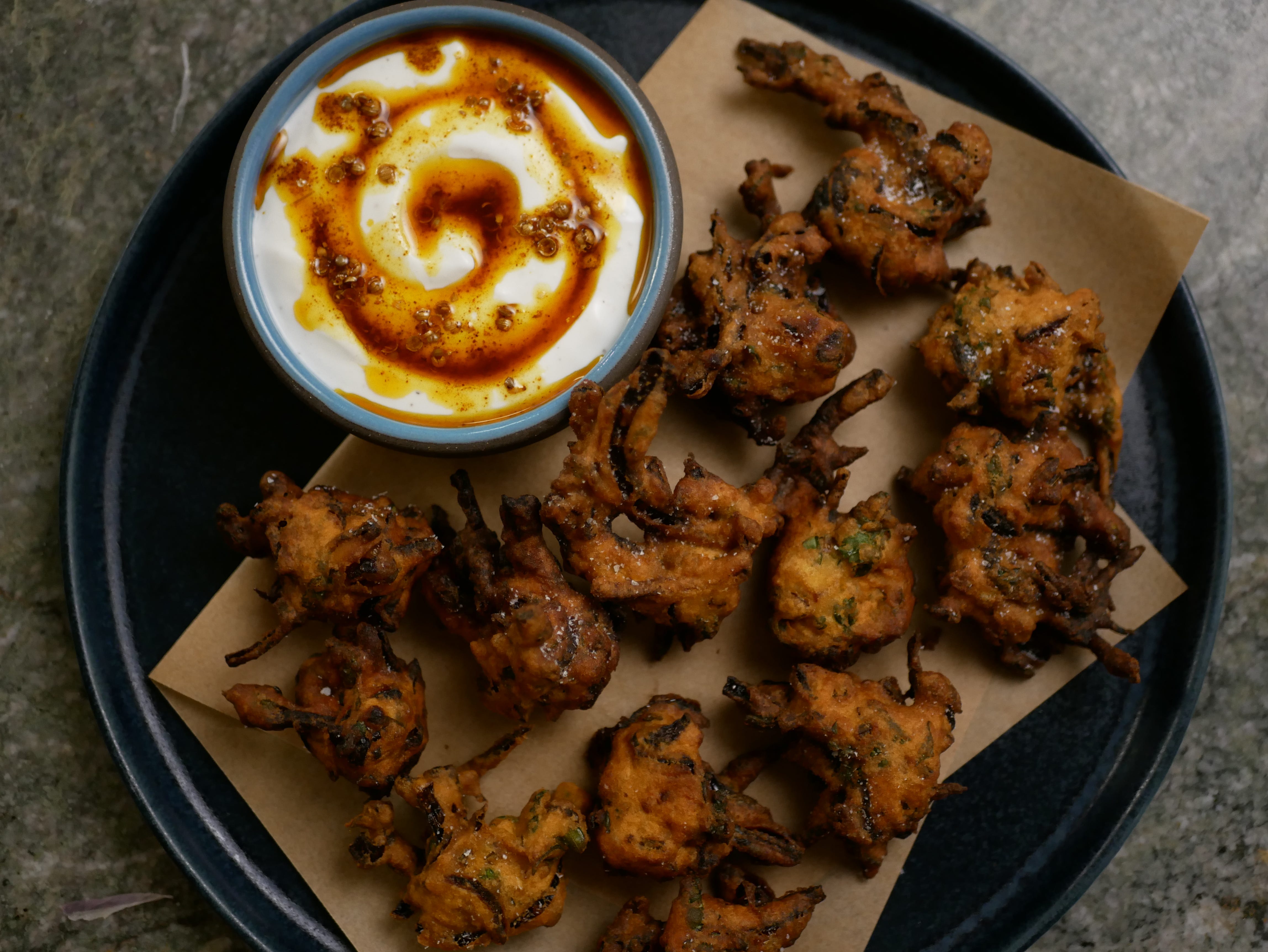
My favorite part of the iftar spread has always been the piyaju. Red lentil and onion fritters spiced with cumin and turmeric, flecked with green chili and cilantro, fried until the edges go crispy and a little ragged. Small, hot, eaten standing up. They don’t require anything from you except your full attention.
I have spent much of my adult life quietly reclaiming things I was once allowed to experience only on other people’s terms. This recipe is a small example of that. I got my job at Bon Appétit by making piyaju for my interview. When they asked me to develop it into something publishable, they had me turn them into zucchini fritters. The zucchini fritters were, for the record, excellent. (Of course, they were. I developed them.) But I have thought about that a lot since.
So here is the actual recipe:
Piyaju (Red Lentil and Onion Fritters)
serves 4 as a snack
1 cup red lentils (masoor dal)
2 teaspoons Diamond Crystal kosher salt, plus more to sprinkle
1 teaspoon ground cumin
½ teaspoon ground turmeric
2 medium red onions, sliced (not too thin)
3 Thai or serrano chilies, sliced (and/or 1 teaspoon Kashmiri red chili powder)
A large handful of fresh cilantro, stem and all, roughly chopped
Ghee or neutral oil, for frying
Rinse the lentils, then cover with cool tap water and set aside to soak at room temperature for at least 1 hour and up to 6 hours. (If they soak too long, the paste will blend too smoothly and the fritters won’t be as crunchy.)
Drain the lentils. In a blender or food processor, blitz the lentils with salt, cumin, and turmeric, adding just enough water to get things moving. You want a thick, coarse paste that’s reluctant to flow off a spoon, so be prudent when adding water.
Scrape the paste into a bowl. Add the onion, green chili, and cilantro, and mix well with your hands.
Prepare yourself for frying: set a rack into a sheet tray and line it with paper towels. Have salt handy for final seasoning and a slotted spoon or spider for evacuation.
Pour about 1 inch of ghee or oil into a small Dutch oven or heavy-bottomed pan. Heat over medium-high until a small amount of batter added to the fat excitedly sizzles and spurts.
Working in batches, drop heaped tablespoons of batter into the oil. (I like to do this with my hands, pinching and plopping dollops into the fat. If you don’t want to get that close to hot oil, use two spoons, dipping them into the oil before scooping to keep the batter from sticking.)
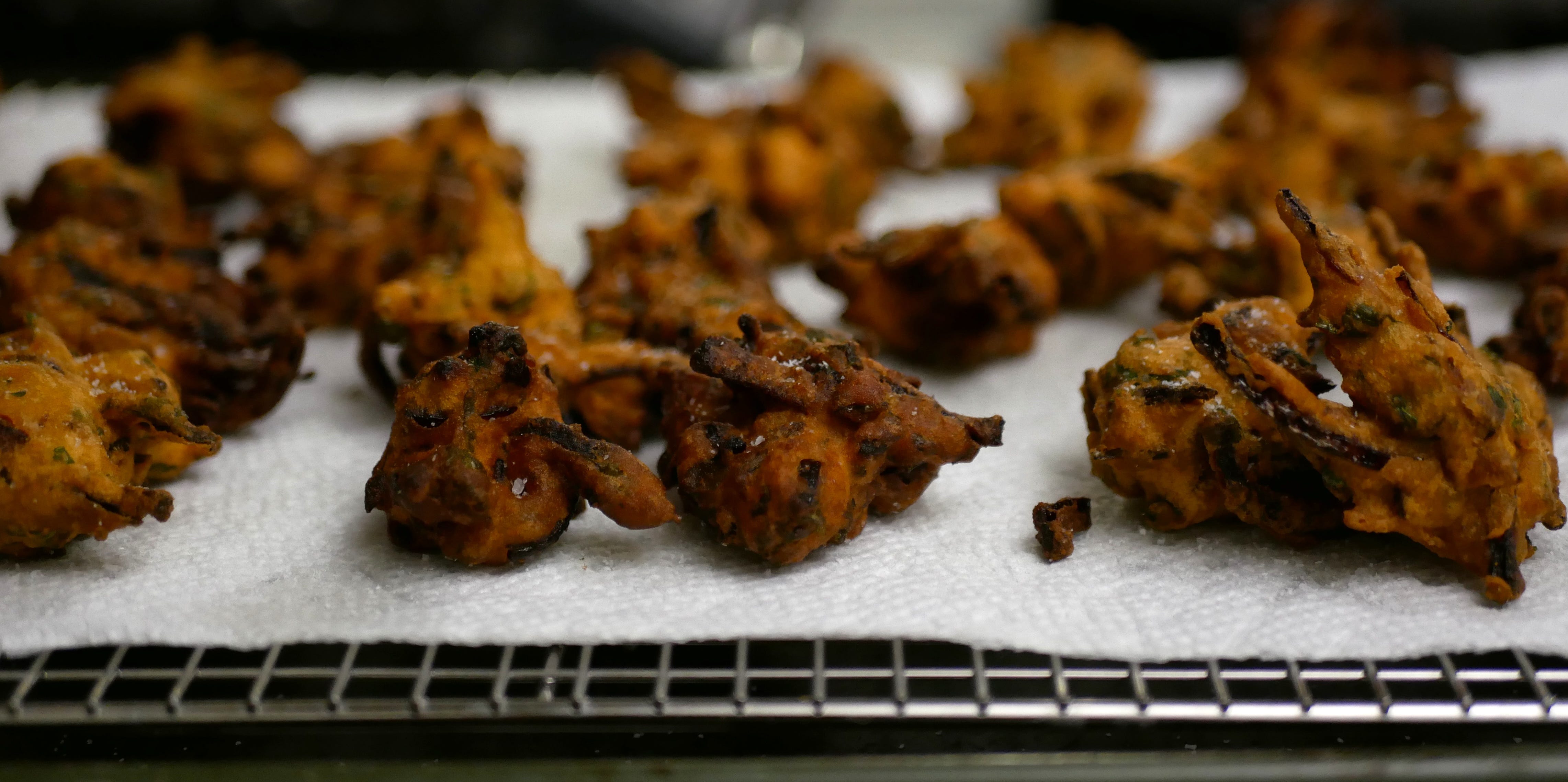
Don’t crowd the pan and turn the fritters occasionally. Fry until very deeply browned—darker than you’d think. They should look a little unruly and almost blackened at the edges. That is correct.
Drain onto the prepared landing zone and season with salt while hot. Eat them as soon as you can without burning your mouth, which is to say, immediately.
Even though it doesn’t need anything, to level it up, serve the piyaju alongside this very good, only slightly fussy raita:
Really Good Raitha
½ cup full-fat strained yogurt
¼ cup buttermilk
2 tablespoons freshly squeezed lemon juice
½ teaspoon sugar
Salt and pepper to taste
2 tablespoons neutral oil
1 teaspoon cracked coriander seeds
Pinch turmeric
¼ teaspoon Kashmiri red chili powder
Stir together the yogurt, buttermilk, lemon juice, and sugar. Season to taste with salt and pepper. Scrape into a shallow serving dish.
In the smallest pan you have, warm up the oil and coriander over medium heat until the seeds pop, about 3 minutes. Add the chili and turmeric, stir, then scrape over the yogurt mixture. Serve right away.
Sohla, as a fellow Bangladeshi, my first introduction to your cooking was your piyaju recipe on Bon Appétit, and I’ve been an admirer ever since. I remember running to show my mom and we were both so surprised but proud to see something so unmistakably Bengali on such a visible platform.
Our culture is incredibly rich, and Ramadan in particular holds a kind of comfort and stillness that transcends religion. You definitely don’t have to be Muslim to feel the warmth of the rituals. Wishing you all the best 🫶🏽
I remember reading your zucchini fritters recipe and thinking to myself - is this piyaju? I hate that you were asked to make the recipe more “publishable” (read palatable) for their specific audience at that time. Knowing the backstory of that post makes the memory of discovering that recipe tainted. I love that you’re reclaiming the recipe in this post. As soon as I read “Rinse the lentils..” I ran downstairs and soaked some right away! We were supposed to be off fried foods for iftar this week (as a weak attempt to watch our cholesterol) but that’s going out the window tonight!
Thank you for being you. I’ve loved you and your work (especially that Morog Polau recipe that sustained me through a tough time). I have followed your career closely through all the ups and downs - I gained a small confidence to share parts of my heritage I didn’t always feel confident sharing. Will always be rooting for your success! I am currently on a side quest to conquering dough and have been slowly working my way through the Dough chapter of your book. Manakeesh is happening this weekend!